Showing posts with label Equipment. Show all posts

Wednesday, September 21, 2011

Kitchen and Household Sanitation


For the past few years, I’ve been using a 10% bleach solution to sanitize around the house.  I know a lot of people are trying to get away from bleach these days, but I love it!  I know it works.  When I took microbiology lab in college, we ended up with a lot of Petri dishes full of all sorts of microbes.  We opened them all up, put them in the sink, and poured bleach over them.  It’s just so effective.

That being said, take safety precautions when using bleach.  Don’t mix it with other cleaners, make sure there is good ventilation, and limit exposure.

Straight bleach is too strong for household use and is not necessary.  Even when cleaning up blood, the protocol is a 10% bleach solution.  So this is what I used around my bathrooms and kitchen.

A few weeks ago, I was introduced to a new household sanitizer.  Once a month, the women at my church get together for Mary and Martha Monday.  Generally, one of the women gives her testimony and teaches us a skill she has.  This month, we had our first man share with us.

Tim is a professional chef and caterer (find his Facebook page here).  He also teaches ServeSafe classes.  He shared his recipe for an all-purpose cleaning solution.  Not only does it sanitize and disinfect, but it is way cheaper than any disinfectant you would find in the cleaning product aisle.

These products are expensive!

His solution still uses bleach, but in a much lower concentration so I feel comfortable using it everywhere.  The addition of vinegar boosts the disinfecting power.  Both of these are great disinfectants in their own right, but put them together, and you’ve got a super disinfectant.  (Source)

So far I’ve used it on the kitchen counters, stovetop, compost bowl, April’s highchair, dining room table, tile floor, laminate floor, and toilet.  He even suggests using it to wash the shells of eggs that will be used in raw-egg recipes (more on that in the future).

Household Sanitizing Solution
1 gallon water
1 oz. (2 Tbsp.) household bleach
1 oz. (2 Tbsp.) 5% distilled white vinegar (the cheap stuff)

Mix all ingredients in a clean gallon jug.


Be sure to clearly label the jug, including the ingredients and their quantities.

I label it on all sides.

Not only does this give you the recipe next
time you need to make it, but then you have
the exact ingredients and quantities to tell
the doctor or poison control in case of
accidental ingestion.


Pour into spray bottles as needed.

I currently have three of these spread
throughout the house and am going to get
more when I can.

All-purpose Cleaner (for greasy messes, food spills, etc.)
1 batch household sanitizing solution
1-2 Tbsp. castile soap

Mix and dispense into spray bottle.

Monday, May 23, 2011

Out with the Old, In with the New: My New Cookware!


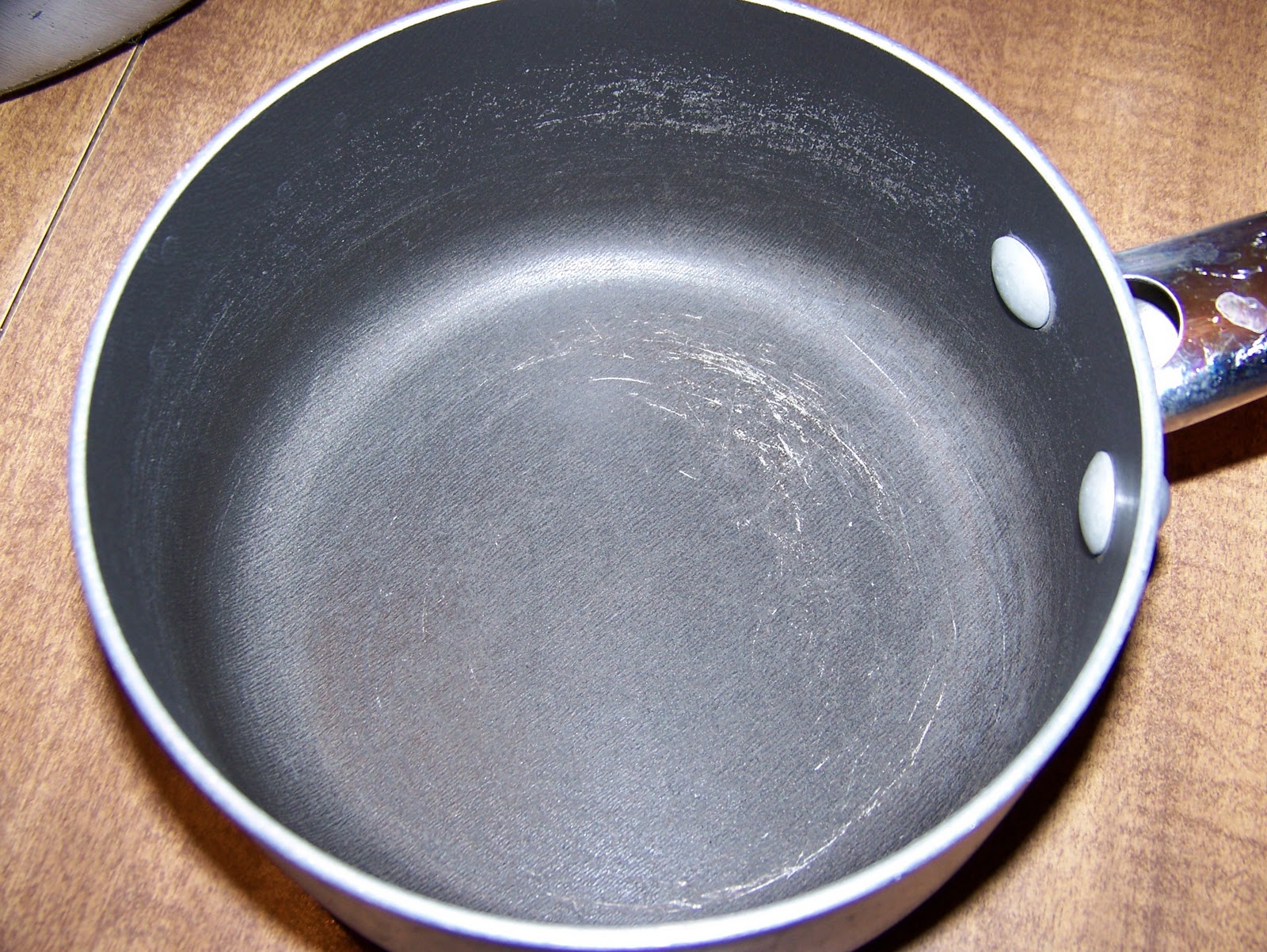
Back in January, Kimiko wrote a post about cookware.  She discussed different types of cookware and the pros and cons of each one.  We then each talked about what we owned.  I had a set of Farberware non-stick cookware that was long overdue to be replaced.  See:


I mentioned that I was waiting until I had the money to buy a quality set that would last the rest of my life.  Well, that day has arrived!!  Thanks to our tax refund, I was able to purchase a new set.  Thanks to a white sauce with black non-stick flecks in it, I had not regrets about throwing the old set away.

I decided on the Kirkland Signature 13-piece stainless steel set.  It's basically the same set Kimiko discussed back in January.  It does have some style variations from her set and slightly different sizes of pans.  But it has the copper bottoms and all metal construction.


The skillets didn't come with lids, but the saute lid fits the large skillet.


I no longer have to worry about scratching the surface.  I can use any utensil I want!  And they hold heat much better than my old set.

Needless to say, I am very happy with my new toys!!  We cannot emphasize enough how important it is to have quality cookware.  It doesn't have to be expensive; this set cost me less than $200.

Of course, now that I have different cookware, I have to go back and do a little re-organizing.

Monday, January 10, 2011

Cookware: Pots and Pans

Cuisinart 77-10 Chef's Classic Stainless-Steel 10-Piece Cookware SetPots and pans are one of the most important pieces of equipment in any kitchen.  Without the proper cookware, it’s sometimes difficult to get the results you’re looking for.  Good cookware is not cheap, so it’s important to choose something that is both high in quality and durable.  There are so many types and brands of cookware, it can be quite overwhelming to know what to look for.  Here are some of the basic facts and characteristics about various types of cookware:

Aluminum: Aluminum is a great heat conductor, which is why aluminum foil can be handled with bare hands shortly after coming out of the oven.  It isn’t a very strong metal, so it is often blended with other types of metals to make more durable cookware.

Copper: Copper is great for cookware because it provides even heating – you don’t end up with hot or cold spots.  These days, you don’t often find pots and pans made of just copper, because copper reacts with acidic foods and is heavy.  Some pans come with a layer of copper laid between two layers of another type of metal – that allows for even distribution of heat without the weight of an all-copper pan or the reactive tendencies of copper.

Cast Iron: Sumiko wrote about cast iron here, but I will say that it is the best type of pan for searing meats.  Most other types of pans don’t get hot enough to get a good sear.  And they truly are really easy to clean if seasoned well.

Stainless Steel: Stainless steel has become popular to use in cookware because of itss durability and the fact that it doesn’t react with foods.  It is, however, a poor conductor of heat, which isn’t a good thing when it comes to cooking.

Nonstick: Nonstick cookware seems to be the most popular type of cookware right now.  There are some advantages to nonstick cookware: little or no fat is needed to prevent food from sticking and it is easy to clean.  However, there are also disadvantages to using nonstick cookware.  Since food doesn’t stick, you can’t really deglaze a pan and get those wonderful bits of flavor!  The coating on nonstick pans isn’t all that durable and your nonstick pots and pans will probably need to be replaced at some point (or multiple times).  In order to prolong the life of your nonstick cookware, it is important to refrain from using metal utensils on them.  Additionally, if a nonstick pan is overheated, it breaks down the nonstick coating.  While we don't recommend nonstick cookware for all your pots and pans, we do recommend you have at least one nonstick skillet for things such as omelets and pancakes.  Basic 10-inch nonstick skillets/frying pans are pretty inexpensive, so it's not a big deal when they need to be replaced.

What we have


Kimiko: I have Kirkland Signature’s Stainless Steel Cookware Set (Costco’s brand). While the materials the cookware is made of are the same, my set varies slightly in the size and types of some of the pans.  I absolutely love my cookware and would recommend it to anyone!  They are durable, due to being made of stainless steel, but at the same time are great conductors of heat as a result of the copper base.  I can use any types of utensils on them; and, since they are all metal (lid and handles), they can also go in the oven (however, the lids and handles often need to be handled with hot pads).  Additionally, I like that it comes with a steamer for the 2-quart pan (the current set has a steamer for a 3-quart pan).  This steamer is much easier to clean than a universal steamer basket!
 

There is one thing I don't like about this set - the skillets.  I tried using them to deep fry a couple times and the oil ended up burning around the edges of the skillets and is very difficult to remove.  The only thing I use the skillets for now is to heat up tortillas.  On a positive note, I was able to deep fry in the saute without a big mess, but now that I have a cast iron skillet, I use that for deep frying.

I have had my set for 4 1/2 years now and they still look great (except for the brown rings around the skillets, of course!)!  I have a feeling these will last a lifetime!
 

Sumiko:  I have a few different types of cookware.  My main set is Farberware nonstick cookware.  For the reasons my sister discussed above regarding nonstick pans, I would NOT recommend it.  I received this set when I got married seven-and-a-half years ago.  I am extremely careful with my pots and pans--no metal utensils, no abrasive scrubbers or cleaners, and I hand wash it.  Yet it didn't take long for the nonstick surface to start developing scratches and nicks.  It really needs to be replaced, but I am holding out until I can afford a quality set that will last the rest of my life.  I do like the nonstick skillet for heating tortillas, making omelets, and scrambling eggs.


Scratches in the 5-quart stock pot.

Scratches in the small sauce pan.

I also have my iron skillet which Kimiko mentioned above.  I love it!  Every kitchen should have at least one good iron skillet.  You can read all about it here.


When Robbie's grandma died about six years ago, I ended up with her Revere Ware 3-quart pot with steamer.  I use this pot more than the pots in my Farberware set.  It is aluminum with a copper bottom and is very sturdy. The handle and lid have plastic on them so you can touch them without hot pads.  Of course this also means it can't go in the oven.  But overall, I really like this piece and wish I had more like it.


For large batches of spaghetti sauce, soup, or chili, I have an aluminum 8-quart Invitations stock pot from Bed Bath & Beyond.  It has a pasta strainer and steamer basket.  I would definitely recommend this pot.


Much of the information used in this post was gathered from Wikipedia.

Monday, November 8, 2010

Slow Cookers

Cuisinart PSC-350 3-1/2-Quart Programmable Slow Cooker
One of my favorite kitchen appliances is my slow cooker.  Slow cookers are capable of cooking a variety of foods: meats, soups, beans, and even desserts!  The best thing about it is that by using a slow cooker, I'm able to save time and money.

Before I had my daughter, I had a 40-hour per week job outside of the home.  When I came home I was usually exhausted and often didn't have much energy left for cooking (nor did we have a dishwasher or counter space, which made cooking and clean-up more of an involved process).  During this time of life, I used my slow cooker as much as I could!  It was so nice to prepare a meal before work in the morning and come home and have dinner already done, not to mention the wonderful smell in the house from dinner cooking all day long.  Sometimes I would prepare everything the night before and then just refrigerate it until the next morning.  That way, in the morning all I had to do was stick the crock in the slow cooker and push start (which is ideal for us non-morning people).  Even though I'm no longer working outside the home, I still use my slow cooker frequently.

One reason I love my slow cooker is because it is a money-saving appliance.  Because of it's cooking process, it's ideal for cheap, tough cuts of meat.  When tough cuts of meat are cooked slowly for long periods of time, they become tender, moist, and delicious.

There are several brands and types of slow cookers with different features.

West Bend 84384 4-Quart Oval-Shaped Crockery CookerBasic: There are basic slow cookers that simply have a switch that has off, low, high, and warm.  You turn it on and it stays on until you turn it off.  There are no bells and whistles here.  Some of them have crocks that are removable and some have crocks that are built-in, which is something to think about when purchasing a slow cooker.  One with a crock that is not removable will be more difficult to clean.


Hamilton Beach 33967 Set 'n Forget 6-Quart Programmable Slow Cooker

Automatic: These slow cookers are a little more advanced than the basic model.  They usually have some sort of timer that will turn the slow cooker either to off or to warm once the time has run out.  Some allow you to put in any amount of time and some limit you to a specific time increments (i.e. 4 or 6 hours for high and 8 or 10 hours for low).  Some even have probe thermometers that you can stick into your meat and once the meat reaches a certain temperature, it will turn the slow cooker off or to low.


What we have:
 
Kimiko: I have a Crock-Pot SCRC507-W 5-Quart Countdown Slow Cooker.  You can set it to low, high, or warm in addition to setting how long you want it to cook (in 30 minute increments).  Once the time has run out, it automatically turns to warm.  This countdown feature is wonderful, since I'm not always home when the food is done cooking.  It's also nice that I can set whatever amount of time I want and I'm not limited to specific time frames.  For example, I can set it on low for just 3 hours if I want to; I'm not limited to 8 or 10 hours on low.  I also don't have to worry about overcooking the meal when I'm not home and when I am home, I don't have to worry about turning it off at a certain time.  Additionally, since it automatically turns to warm instead of turning off, I don't have to worry about my food getting cold and reaching an unsafe temperature - it stays hot until we're ready to eat.


Sumiko:  I have two slow cookers.  When I went away to college, someone gave me a 2.75-quart manual Rival Crock-Pot.  Although I have a large family, I really like the smaller capacity of this one for smaller batches.  I love steel cut oats but never have time to cook them in the morning.  I just put oats and water in this small Crock-Pot before I go to bed and I have delicious, warm oat meal in the morning.
                                              
There are two things I do not like about this slow cooker.  First, the crock is not removable, making washing a hassle.  Second, it came with a plastic lid.  I have a casserole dish with a glass lid that fits that I use instead.  The particular model I have is no longer available.  Fortunately, the comparable models that Rival now makes have removable crocks and glass lids.  You can find them here, priced from $19.99 for a 2.5-quart to $29.99 for a 3.5-quart.

I also have a newer 5-quart oval Rival Crock-Pot Smart-Pot which is also no longer available.  They now make 5-quart round and 5.5- and 6-quart oval Smart-Pots, available here for $24.99 to $54.99.  The Smart-Pot series allows you to program it for 4 or 6 hours on high or 8 or 10 hours on low.  Once the time has elapsed, it automatically switches to the warm setting.  I really like this slow cooker, and it is the perfect size for our family.  There have been a few occasions when I wished I could manually turn it to warm.

What we use it for:
  • Beans 
  • Chicken
  • Roasts
  • Soups and stews
  • Hot apple cider
  • Oatmeal
  • Taco/Burrito filling
  • Desserts

    Monday, November 1, 2010

    Thermometers

    There are many kinds of kitchen thermometers available to the home cook.  With everything from single use pop-up timers to infrared kitchen thermometers lining the walls of kitchen supply stores, choosing the thermometer that is right for you can be a daunting task.

    I believe every home cook should have at least three kitchen thermometers:  an oven thermometer, a refrigerator/freezer thermometer, and a food thermometer.

    Refrigerator/freezer thermometers are the best way to make sure you are storing cold and frozen foods at the correct temperatures.  Refrigerators should be kept between 33° and 40° Fahrenheit.  Freezers should be below 0° Fahrenheit.  Some new fridges and freezers come with a digital display that tells you the internal temperature.  Even if you have this feature, I would still recommend a separate refrigerator/freezer thermometer.  The built-in thermometer only measures the temperature in one spot.  In reality, there are often “hot” and “cold” spots in refrigerators and freezers.  I always keep my thermometer inside and move it around often to be sure all areas are within safe temperature range.


    An oven thermometer is not as necessary as a refrigerator/freezer thermometer but still highly recommended.  Just as there are “hot” and “cold” spots in a refrigerator, so there are “hot” and “cold” spots in ovens.  Also, the oven’s built-in thermometer will only measure the temperature in one spot.  If you have an older oven like I do (mine’s 30 years old), the calibration is likely to be off.  Because I have an oven thermometer, I know that my oven runs about 25-50° hotter than the dial says.  By having a stand-alone thermometer in my oven, I can adjust the temperature to what I need (especially important when baking).


    The thermometer that is the most confusing to purchase is a food thermometer—there are just so many options.  I will discuss just a few.

    Single-use pop-up timers:  These are often sold in turkeys but are also available at kitchen supply stores.  They are surprisingly accurate for how simple they are, but I do not recommend them at all.  Because they are single-use, they only measure the temperature in one spot.  Just because the turkey breast is done, does not mean the thigh is done.


    Dial thermometers:  Any thermometer with a dial is going to take more time to register actual temperature than a digital thermometer.  Even “instant read” dial thermometers take 15-20 seconds to show an accurate temperature.  One advantage that dial thermometers have over many digital thermometers is that they can be calibrated.  Some are oven-safe and can remain in the food while it cooks.


    Digital stick thermometers:  These read faster than dial thermometers but cannot be used in the oven.  Some can be calibrated.


    Digital probe thermometers:  These are by far the most versatile food thermometers and the ones I recommend.  They can be used in the oven with the display out of the oven.  Our dad even uses his in his grill (he wraps the cord in foil to prevent it from charring).  They have a wide temperature range so they can even be used for candy-making and frying.  Because the probe can stay in the food while it is cooking and the alarm will let you know when it is done, you also avoid overcooking.


    Infrared kitchen thermometers:  While these new thermometers are extremely accurate, they can only tell you surface temperature.  Most of the time you are interested in internal temperature.  Infrared thermometers are mostly useful for checking the temperature of your skillet or oil.


    What we have:

    Sumiko
    Food thermometer:  I have a TruTemp instant read probe thermometer.  It is now sold under the Taylor name and is available here.  I absolutely love it!  It displays the current temperature as well as the target temperature and has an optional alarm to alert you when your food reaches the desired temperature.  It also has a built-in timer and a temperature chart on the back that tells me the minimum temperature required for different types of meat.

    Refrigerator/freezer thermometer:  I have a TruTemp 3503 refrigerator/freezer thermometer.  The 3509 is very similar and is available here.  It works great and can be sat on the shelf or suctioned to the wall.  It also has color-coding so you know what the ideal temperatures are.

    Oven thermometer:  My oven thermometer is so old that it is not available any more.  I think I took it from my parents’ kitchen when I went to college or got married.  Anyway, it is made by Cooper.  A similar one can be found here.  A nice feature is that you can set it on an oven rack or hang it from the rack so it’s out of the way.

    Kimiko
    Food thermometer: I have two food thermometers.  When we got married, I got a dial thermometer.  It's a Pyrex Candy Thermometer, but can be used for almost anything I make, because the range is from 100 to 500 degrees Fahrenheit.  They don't make it anymore, but it's similar to the one pictured in the dial thermometer section above.  Last Christmas, my husband got me an Oneida Digital Probe Thermometer.  It does take a little while for it to register the correct temperature, but I like the fact that it has a temperature alert so that it will notify me when the correct temperature has been reached and I don't have to keep checking it.  It also has a timer and can be used in either Fahrenheit or Celsius. 

    Refrigerator/Freezer thermometer: I have a Temprite thermometer, but I can't find it anywhere, so I'm guessing they don't make it anymore.  However, it is similar to this one.  As with Sumiko's it has suction cups and also has color coding so you'll know whether you're in a food safe range at a glance.

    Oven thermometer: I never really thought about the necessity of an oven thermometer until someone gave one to me when I got married.  It was one of those gifts I didn't register for, but I'm sure glad I got it!  I have the Oxo Good Grips Oven Thermometer and it has been helpful as we've moved and had new ovens to figure out.  It can also sit on the rack or hang below it, which is a nice feature. 

    What we use it (food thermometer) for:

    Saturday, September 11, 2010

    Iron Skillet Follow-up: Lids and a Great Sale!


    On Wednesday I posted about iron skillets.  Both Kimiko and I mentioned that we love our iron skillets but wish they had come with lids.  My old friend Paul read that and referred me to this site where you can buy cast iron lids!  The 10” lid is only $10!!


    Unfortunately, they don’t carry a 12” lid, so I searched around and found a great deal being offered by Lodge right now.  September 10-27, Lodge is having a 20% off sale for selected products including 10¼” and 12” glass covers!  That makes them $16.95 and $20.95, respectively.  The sale also includes skillets, deep skillets, and Dutch ovens, all with lids, as well as a reversible stove-top griddle.  If you’re looking for iron cookware, now is a great time to buy.


    Wednesday, September 8, 2010

    Iron Skillet


    One thing every kitchen should have is a good cast iron skillet.  I did not have one until about three years ago, and now I wouldn’t be without one.

    Iron cookware has been used for hundreds of years and continues to pass the test of time because of its many cooking advantages.  Iron can withstand very high temperatures, making it great for searing, pan-frying, and oven use.  It also holds heat very well so there are minimal temperature fluctuations when food is added to the pan.

    Another great characteristic of iron skillets is their ability to be seasoned.  With proper use and care, iron cookware develops a non-stick surface.  This makes iron pots and pans suitable for cooking a wide-variety of foods including meat, eggs, casseroles, and some cakes.  I’ve even used mine to make English muffins.

    I made these scrambled eggs with no sticking.


    Cooking with an iron skillet also has nutritional advantages.  During the cooking process, small amounts of iron leach out of the pan and into the food.  Iron is an element that is required by the blood to carry oxygen throughout the body.  Anemics are encouraged to use iron cookware.

    One of the main disadvantages of iron cookware is that it is very heavy.  Of course, this is partially what makes it so heat retentive.

    The key to getting the most out of your iron cookware is proper use and care.  If cared for properly, you should never have to replace an iron skillet.  Season your iron cookware before the first use and at least once a year after that.

    Seasoning Iron Cookware
    Place cookware on the top rack of a cold oven with a baking sheet on the bottom rack.  Turn the oven on to 350°.  When the pan is warm (not hot) remove it from the oven and spread completely with vegetable shortening.  Be sure to season all surfaces:  inside, outside, bottom, and handle.  Return to preheated oven and bake for 1 hour.  Turn off heat and let cookware cool slightly in oven.  Remove; wipe with paper towel.

    When it comes to cleaning iron cookware, it needs some special attention to maintain its season.  I never use soap on mine and never soak it (soaking can cause the iron to rust).  If there is any cooked on food, I simply deglaze it.  I then clean it with shortening and kosher salt which re-seasons it for the next use.

    Deglazing Iron Cookware (to remove cooked-on food)
    Heat the pan over medium-high heat.  When it is really hot, add enough water to cover bottom of pan ¼-½ inch.  Use a wooden spoon to scrape off cooked-on food.  Pour water out.  Note:  this liquid is very flavorful and can be used in some dishes.

    Cooked-on food remaining
    after sautéing chicken
    I even let this sit overnight to show
    how well this cleaning method works

    Getting the pan hot.  Notice that the
    cooked-on grease is actually foaming.
    Use care when adding the water as it
    will steam immediately
    Scraping the food off

    Cleaning Iron Cookware
    Heat pan over medium-high heat.  Add a dollop of vegetable shortening and let melt.  Add some kosher salt.  Scrub with paper towels until clean, being careful of hot oil (can use tongs to hold paper towels).  Quickly rinse with hot water.  To dry, place in cold oven.  Turn oven to 350°.  Turn oven off when it reaches 350° and let pan cool in oven.  If necessary, wipe with a little vegetable shortening before next use.

    Melting the shortening
    Adding kosher salt.  Kosher salt is
    coarser than table salt.
    Scrubbing with paper towels--this may
    be done with tongs
    Your pan should be black and
    shiny when finished
       

    What we have

    Sumiko:  I have an Emeril Lagasse 12 inch iron skillet (available here).  Even though it is pre-seasoned, I still recommend seasoning it before the first use.  I absolutely love it, though I wish it had a lid.  When I do need a lid, I just use aluminum foil.

    Kimiko:  I have a Lodge Logic 12 inch cast iron skillet (available here).  I've only had mine for a couple of months, but I love it!  As with Sumiko's, I also wish it had a lid.  One of the great things I love about cast iron is that it can be used on the stovetop and in the oven, so if you have something that you would normally cook on the stove, but want to put it in the oven to crisp up the top, you can easily do it.  I'm also considering getting a smaller cast iron skillet to make smaller quantities and to make cornbread (the 12 inch spreads the batter too much, resulting in a very thin cornbread).  If you're hesitant about getting a skillet because you don't have much storage space in your kitchen, you can store it in your oven.

    What we use it for
    Related Posts with Thumbnails